


History of the Civil Register in Italy: when it emerged in each region
When researching the history of Italian ancestors, it is common for the question to arise about where to conduct genealogical research. One of the most frequent questions is: when did the civil register emerge in Italy?
The answer to this question is more complex than it seems, as it is linked to historical events and different regional influences.
Religious origins: the first parish records
Records of baptisms, marriages and deaths in Italy began to be documented by some churches from the 15th century. In Florence, for example, the first baptism dates back to 1450, whilst in Pisa, the first records date from 1457.
However, the essential landmark for parish records was the Council of Trent, held in 1563. The reform imposed the requirement to record these religious events, although the implementation of this determination varied according to the region.
The initial records were limited in detail, as illustrated by the following example of a baptism:

This baptism took place on 12 June 1569, in Popoli, Pescara. The child is named Donato, son of Francesco di Mascio.
The French Revolution and the creation of the civil register in Italy
Religious records were the main form of official documentation for vital events for centuries and continue to exist to this day. However, with the French Revolution in 1789, secularism gained strength, particularly in Italian regions under French rule.
This context created a contradiction: the churches, hitherto responsible for records, could no longer maintain this exclusive role. Thus, the introduction of the civil register became inevitable.
The implementation of the civil register in Italy occurred gradually, starting in 1796 in some parts of Liguria and, later, in 1809, in the south of the country. However, regions such as Sicily, Sardinia, Trentino-Alto Adige and Venezia Giulia remained outside Napoleonic rule and did not implement the civil register during this period.
An interesting example is the case of Cremona, which, after joining the Cisalpine Republic, already had a civil register in 1797.
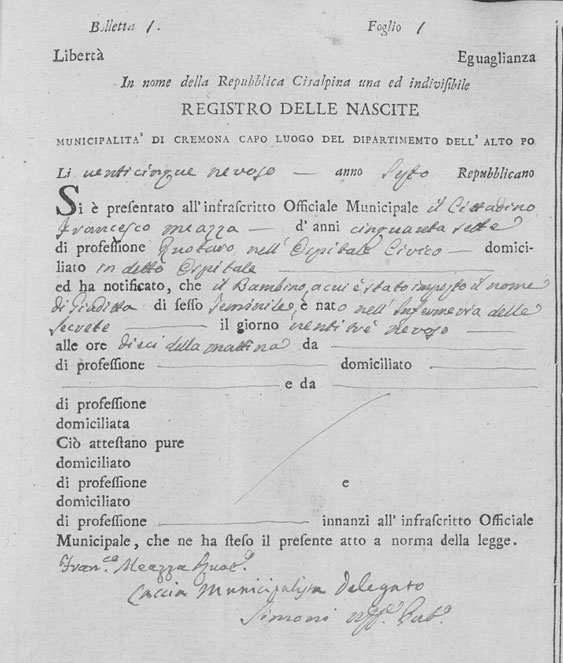
The first record in Cremona occurred on 25 Nivôse (fourth month of the revolutionary calendar, equivalent to the period from 21 December to 19 January) 1797. Giuditta, registered by Francesco Meazza, of the Ospitale Civico, was born in the infirmary on 23 Nivôse, at 10 in the morning. On the same page, three other records of exposed children were also made by Meazza.
Impact after the fall of Napoleon
With the fall of Napoleon in 1815, after the Battle of Waterloo, civil registers were discontinued in several Italian regions. The political reorganisaton of Europe brought to light the need to decide the future of these records.
Some regions, such as Calabria, Basilicata, Puglia, Campania, Molise and Abruzzo, maintained the civil register from 1809, whilst others, such as Tuscany, Lombardy, Marche and Emilia-Romagna, faced disruptions in the continuity of civil records.
Specific cases
The situations in the regions of Tuscany, Lombardy, Marche and Emilia-Romagna were more complex. Some of these areas maintained civil records continuously, whilst others experienced disruptions. In certain duchies, such as Lucca and Massa-Carrara, civil registers were discontinued.
Veneto
In the Veneto region, comprising the provinces of Belluno, Padua, Rovigo, Treviso, Venice and Verona, the civil register suffered disruptions in 1815, but was resumed in September 1871.
However, three comuni in the province of Belluno (Cortina d’Ampezzo, Colle Santa Lucia and Livinallongo del Col di Lana) remained outside this process, belonging to the Austro-Hungarian Empire.
Sicily and Sardinia: introduction of the civil register
Sicily and Sardinia were not under Napoleonic rule, which resulted in the non-implementation of the civil register in these regions during that period.
It was introduced in Sicily in 1820 and in Sardinia in 1866, without subsequent disruptions.
Northern Italy
In the regions of Piedmont, Aosta Valley and Liguria, the civil register was introduced by Napoleon, with dates varying. After the fall of Napoleon, each region or province took its own course regarding the civil register.
Former Austro-Hungarian Empire
In the Friuli Venezia Giulia region, which includes the provinces of Gorizia, Trieste, Udine and Pordenone, we find a distinct reality that requires careful analysis.
Part of this region was not influenced by Napoleon, which resulted in the non-implementation of the civil register between the years 1804 and 1811. This area, known as the “Austrian Littoral”, covers the provinces of Gorizia and Trieste, as well as several municipalities in the province of Udine, such as Aiello del Friuli, Aquileia, Campolongo al Torre, Cervignano del Friuli, Chiopris-Viscone, Fiumicello, Malborghetto Valbruna, Pontebba, Ruda, San Vito al Torre, Tapogliano, Tarvisio, Terzo di Aquileia, Villa Vicentina and Visco.
Only in 1924, following the First World War and subsequent annexation to Italy, was the civil register implemented in this part of the territory.
In the remaining regions of the province of Udine and throughout the province of Pordenone, the scenario is similar to that of Veneto: the civil register was initiated during the Napoleonic period, suspended in 1815 and restarted in 1871.
As for the region of Trentino-Alto Adige and the three municipalities in the province of Belluno, the situation is analogous to that of the Austrian Littoral. These areas were never under the rule of Napoleon, resulting in the absence of the civil register.
They remained under Austrian control until 1920, when they became part of Italy and, from that moment on, the civil register was implemented.